Research & evidence
Re2O clinical research: the evidence, with the details that matter
Useful product information should make the research understandable, including its limits. The sources below distinguish clinical findings, experimental research and reported safety events.
Study 01
A randomised split-face clinical trial
Published 26 February 2026 · International Journal of Molecular Sciences · Read the full paper
- 20 participants
- 20-week follow-up
- Re2O + HA versus HA alone
- Who took part?
- Twenty adults aged 30–65 with moderate cheek roughness, studied at one centre in South Korea.
- What was compared?
- A mixture containing Re2O and HA on one side of each participant’s face, compared with HA alone on the other side. Participants and outcome assessment were blinded.
- How long?
- Twenty weeks of follow-up.
- What did the authors report?
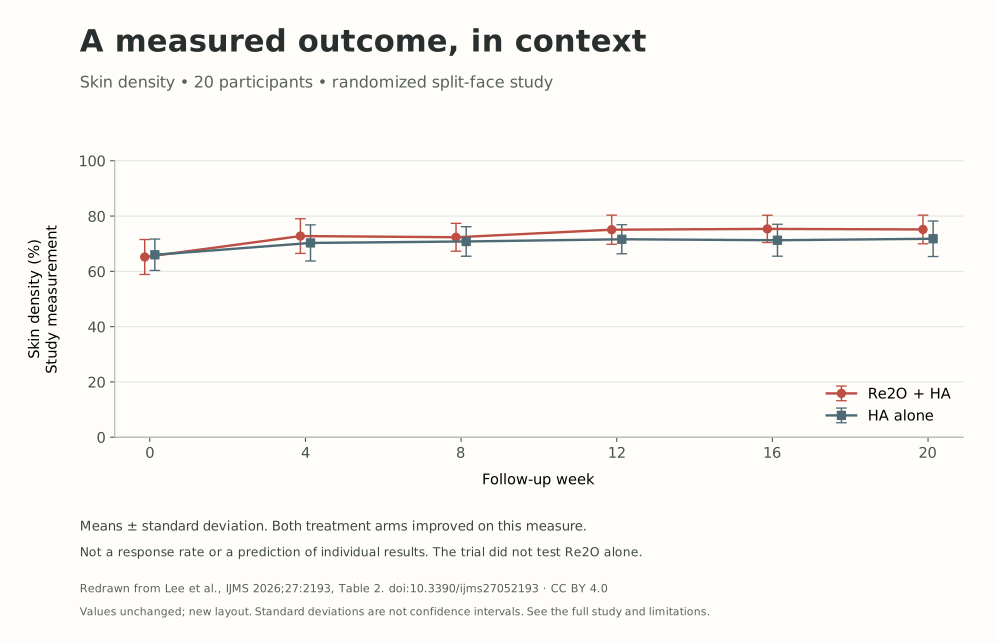
- Differences favouring the combination in several measured outcomes, including skin density, hydration, pore area and elasticity, at particular follow-up visits. The timing and magnitude differed by outcome. Both sides improved on some measures.
- What does that mean?
- The study provides early clinical evidence for the tested combination. It does not establish Re2O-only results, superiority over every other injectable, a standard treatment plan for everyone or a guaranteed duration of effect.
- Safety in this trial
- No serious adverse events were reported in the 20 participants; mild redness and swelling were reported. A trial of this size and duration cannot reliably rule out uncommon or delayed complications.
- Disclosures
- The paper reports no external research funding, acknowledges product support from L&C BIO and a fellowship, and discloses that an author advised on Re2O development. The trial registry entry (NCT07155278) was posted after study completion.
Small single-centre study · combination treatment · 20-week follow-up · not a prediction of your result
Study 02
A reported vascular complication
Published 14 July 2026 · Journal of Cosmetic Dermatology · Read the full report
A case report describes a patient who developed a suspected vascular complication after Re2O injections at another clinic. The report records delayed symptoms and subsequent residual scarring in a patient-provided follow-up image. The original injection technique and preparation could not be verified, and formal follow-up was limited.
A single case cannot establish how often a complication occurs or prove the mechanism. It does show why the absence of serious events in a small trial must not be presented as an assurance that serious complications cannot occur. The report also notes that the matrix itself would not be dissolved by hyaluronidase, so reversibility should not be assumed.
Laboratory and preclinical work
The trial paper also reports cell, tissue and animal experiments examining matrix-related and skin-quality mechanisms. Keep these results separate from the clinical trial when assessing the evidence. Findings in experimental models do not establish the size or duration of a treatment effect in a patient.
How we present research
We identify the tested product and comparator, disclose study size and follow-up, link to the original source and distinguish reported findings from established long-term outcomes. Read our sources and editorial policy.