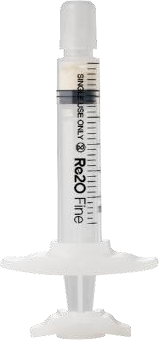
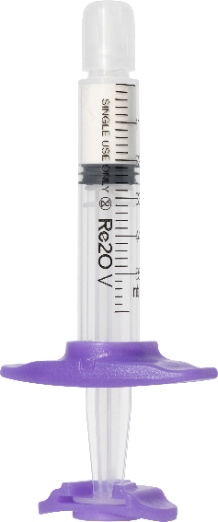
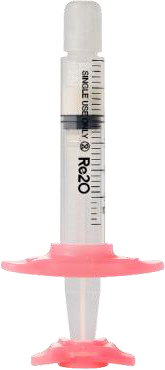
Manufacturer-reported specifications for Re2O, Re2O Fine and Re2O V. Average particle size is different from the amount of matrix in each product.
AT A GLANCE
Three formulations. One matrix approach.
Discover Re2O, Re2O Fine and Re2O V.
Re2O
150 mg
Overall skin quality
Re2O Fine
50 mg
Delicate areas
Re2O V
300 mg
Deeper structural support
Nominal average particle size1A manufacturer-reported average
75 µm0.075 mm
50 µm0.050 mm
250 µm0.250 mm
Amount of matrixMass, not liquid volume
150 mg
50 mg
300 mg per syringe
Manufacturer focus
Overall skin quality
Delicate areas
Deeper structural support
Manufacturer target areaSlide 2 of the manufacturer presentation
Mid dermis
Upper dermis (delicate areas)
Deep dermal to soft tissue
Material
Particulate human acellular dermal matrix (phADM)A tissue-derived extracellular matrix.
Source
Donated human dermal tissue
Manufacturer
L&C BIO · South Korea
Re2O
Nominal average particle size
75 µm (0.075 mm)
Amount of matrix
150 mg
Manufacturer focus
Overall skin quality
Manufacturer target area
Mid dermis
Material
Particulate human acellular dermal matrix (phADM)
Source
Donated human dermal tissue
Manufacturer
L&C BIO, South Korea
Re2O Fine
Nominal average particle size
50 µm (0.050 mm)
Amount of matrix
50 mg
Manufacturer focus
Delicate areas
Manufacturer target area
Upper dermis (delicate areas)
Material
Particulate human acellular dermal matrix (phADM)
Source
Donated human dermal tissue
Manufacturer
L&C BIO, South Korea
Re2O V
Nominal average particle size
250 µm (0.250 mm)
Amount of matrix
300 mg per syringe
Manufacturer focus
Deeper structural support
Manufacturer target area
Deep dermal to soft tissue
Material
Particulate human acellular dermal matrix (phADM)
Source
Donated human dermal tissue
Manufacturer
L&C BIO, South Korea
1 Specifications and target areas follow L&C BIO's Re2O V portfolio presentation dated 28 October 2026, slides 2–3. Targets describe manufacturer positioning, not an injection guide. Nominal average sizes do not show the full size distribution. Confirm the applicable local product information and intended use. Understand particle size
MEET THE MATERIALHuman dermal matrix, brought into focus.
Published clinical research explored Re2O combined with non-crosslinked hyaluronic acid over 20 weeks, with selected measurements favouring the combination.
These patient results relate to the original Re2O combination studied. They do not establish equivalent results for Re2O Fine or Re2O V.
20
adult participants
20
weeks of follow-up
2026
publication year
Split-face
randomized, double-blinded
Re2O + non-crosslinked HATest treatment
compared with
HA aloneControl treatment
A closer look at the results.
Relative change from baseline, calculated from the published group means.
01
Measured skin density
+15.3%Re2O + HA · week 20
Re2O plus HA: +15.3%
HA alone: +8.8%
Imaging-measured skin density.
02
Measured skin hydration
+21.4%Re2O + HA · week 20
Re2O plus HA: +21.4%
HA alone: +14.1%
Instrument-measured skin hydration.
03
Measured pore area
−32.4%Re2O + HA · week 20
Re2O plus HA: −32.4%
HA alone: −16.7%
Measured pore area at week 20.
Re2O + HAHA alonePercentages describe changes in group means, not individual response rates.
See the measurements behind these percentages +
Table 2: baseline and week-20 means ± standard deviation.
Measure
Re2O + HA Baseline → Week 20
HA alone Baseline → Week 20
Skin density (%)
65.185 ± 6.316 → 75.154 ± 5.189
65.998 ± 5.680 → 71.789 ± 6.423
Hydration (grey index)
114.345 ± 21.678 → 138.869 ± 14.275
117.206 ± 21.243 → 133.737 ± 13.324
Pore area (mm²)
61.985 ± 28.812 → 41.908 ± 28.787
58.311 ± 28.865 → 48.574 ± 25.598
Calculation: (week-20 group mean − baseline group mean) ÷ baseline group mean × 100. Selected endpoints, not the complete trial results.
Explore the study details+
The study assessed a combination treatment, rather than Re2O alone. The amount of HA differed between the test and control preparations. These results should not be treated as proof of an isolated Re2O effect.
Twenty participants at one centre and 20 weeks of follow-up provide early evidence. They do not establish long-term durability, uncommon risks, superiority over other ECM products or equivalent results for Re2O Fine or Re2O V.
L&C BIO supplied the study products; one author reported a product advisory role. Laboratory and animal findings in the same paper are separate from these patient outcomes.
L&C BIO describes larger, more continuous ECM particles in Re2O V. Its collagenase laboratory testing and rat implantation comparison suggest more gradual degradation than Re2O in those models. These findings do not establish longer-lasting results, greater safety or better outcomes in people.
Manufacturer presentation, 28 October 2026, slides 4–6. Further clinical evaluation is needed.
02 THE MATERIAL STORY
Meet the matrix.
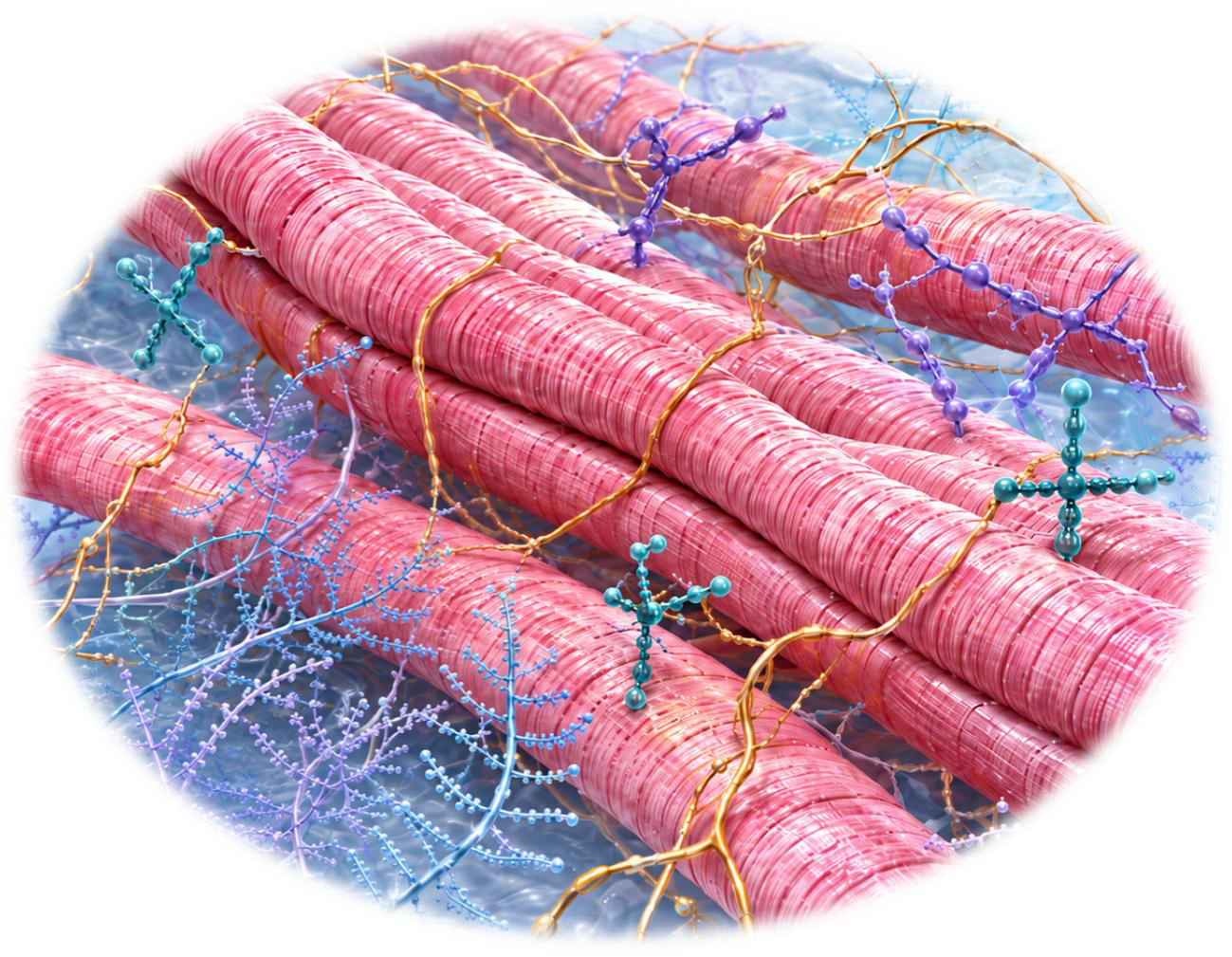
There’s a structural network beneath the skin’s surface. It’s called the extracellular matrix, or ECM.
Conceptual illustration of dermal matrix.
At Re2O’s core is human acellular dermal matrix: processed dermal tissue containing components including collagen, elastin and glycosaminoglycans.
01
Collagen
Structural protein.
02
Elastin
Elastic properties.
03
Glycosaminoglycans
A water-binding environment.
Human dermal tissue, processed into an acellular matrix and micronized into small particles.
03 THE TECHNOLOGY
The thinking behind Re2O.
A tissue-derived material. A distinctive processing approach. A focus on collagen structure.
01
Human dermal tissue
The starting point for the matrix.
02
SFD processing
Surfactant-Free Decellularization.
03
Micronized matrix
The processed material, in small-particle form.
THE PROCESS
Meet SFD.
Re2O is processed using Surfactant-Free Decellularization, a technology protected as a trade secret.
SFD
Surfactant-Free Decellularization
Processing terminology supplied by L&C BIO.
THE STRUCTURE
Small particles. Retained structure.
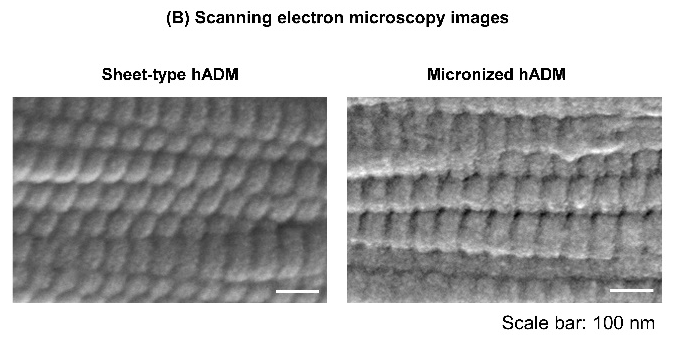
Re2O’s Tri-Core processing refers to retaining the three-dimensional collagen structure after micronization.
What you are looking at: highly magnified electron microscope images of the collagen fibres inside the matrix. One image shows the matrix in its original sheet form; the other shows it after it has been finely ground (micronized) for Re2O. The aim is to show that the collagen fibres keep their structure after processing. The small bar in each image marks 100 nanometres, about a thousand times thinner than a human hair. Source: Lee et al. (2026), Figure 3B. Explore the publication
04 A CLOSER LOOK
The detail is in the matrix.
Fine, Re2O and V differ in particle size and matrix amount. These specifications describe different formulations, rather than a ranking of treatment results.
Nominal average particle size
Re2O75 µm
0.075 mm
Re2O Fine50 µm
0.050 mm
Re2O V250 µm
0.250 mm
050100150200250 µm
Manufacturer-reported nominal average particle size. The chart compares averages, not the full distribution or clinical effectiveness.
Size is part of the story.
Re2O combines a micronized format with a retained collagen structure.
Explore the whole product.
The material, processing and specifications all contribute to understanding its profile. Particle size is one of those details.
An average summarizes reported particle sizes; it does not show the complete range or the largest particle. Size alone cannot establish better outcomes or greater safety. Clinicians can review the measurement method, size distribution, prepared-material characteristics and validated handling information. The published trial did not compare particle sizes or competing ECM products.
THE COMPANY BEHIND RE2O
Korean expertise. Built over time.
Re2O builds on human tissue-based products and dermal matrices developed since 2011, carrying that experience into a new chapter focused on skin quality.
2011
The foundation.
L&C BIO is established in South Korea.
2012
Dermal matrix expertise.
MegaDerm joins the portfolio.
2018
A public company.
Listed on KOSDAQ, a South Korean stock market.
2022
A wider footprint.
Construction of the company’s China manufacturing facility is completed.
2024
A new chapter: Re2O.
Re2O is introduced.
2026
Research, published.
Re2O clinical and laboratory research is published.
Tissue-processing equipment shown in the company profile.
EXPERIENCE BEHIND THE MATERIAL
From MegaDerm to Re2O.
Re2O builds on earlier products made from processed human dermal tissue.
Company milestones and capabilities: L&C BIO company profile, 2026.
YOUR NEXT STEP
A new chapter starts with a conversation.
Bring your skin goals and questions to a qualified aesthetic doctor. Explore the product, discuss your options and find out whether Re2O fits your treatment plan.
Discuss your skin, medical history and treatment options.
03
Plan the next step.
Your doctor can explain suitability, treatment and follow-up.
Injection treatments carry risks, including redness, swelling, bruising, infection, lumps and blood-vessel injury. Your doctor should discuss these with you.
Seek urgent assessment after treatment for unusual or worsening pain, concerning skin-colour changes or visual symptoms.
Treatment considerations & published safety information+
No serious adverse events were reported in the 20-person trial; its size cannot rule out uncommon or delayed complications. A separate Re2O case report describes suspected vascular compromise with scarring, without establishing frequency or verifying the original technique.
The dermal matrix is different from HA gel and should not be presented as reliably dissolvable with hyaluronidase. Treatment areas, preparation and timing depend on individual assessment and the applicable product instructions.
Product profile, processing and published research, together in one place. Use the current local product information and instructions for use for clinical decisions.
Re2O 150 mg · Re2O Fine 50 mg · Re2O V 300 mg per syringe
Nominal average size
Re2O 75 µm · Fine 50 µm · V 250 µm. Manufacturer-reported; V figures from the 28 October 2026 presentation.
Article-reported composition
Approximately 80% collagen, 3% elastin and 0.4% sulfated GAGs, reported for the material tested in the original article only. These are not a batch release certificate and do not describe every variant.
Processing terminology +
Re2O is processed using SFD. AlloClean is associated with earlier products, including MegaDerm. SFD is described as a trade secret rather than a patented process. Tri-Core refers to retained three-dimensional collagen structure after micronization.
Documents to review before use +
Confirm the exact local SKU, current label and IFU, intended uses, contraindications, preparation, administration, storage and traceability. Request particle-characterization data, measurement methods, the size distribution, prepared-material characteristics and validated compatibility information.
Preparation volumes and administration should follow the current applicable local instructions for use.
Scope of the clinical evidence +
The 2026 randomized split-face study enrolled 20 adults and assessed a Re2O + non-crosslinked HA combination over 20 weeks. HA amounts differed between preparations. It did not compare particle sizes, competing ECM products, Re2O Fine or Re2O V. Multiple outcomes were assessed without an overall multiplicity adjustment.
COMMON QUESTIONS
A little more clarity.
Is Re2O the same as an HA skin booster? +
Re2O’s core material is human acellular dermal matrix. Hyaluronic acid is a different material. HA was used alongside Re2O in the published clinical study, but that does not make the matrix itself an HA gel.
Is Re2O made from human tissue? +
Yes. Its starting material is donated human dermal tissue, processed into an acellular matrix and micronized. It is not intended to deliver living donor cells. Discuss any questions about tissue origin, donor screening and traceability with your practitioner.
How do the three Re2O formulations differ? +
The manufacturer reports 50 mg / 50 µm for Fine, 150 mg / 75 µm for Re2O, and 300 mg / 250 µm for V. Their positioning spans delicate areas, overall skin quality and deeper tissue support. A higher matrix amount or larger particle size does not automatically mean a better result.
Does Re2O V last longer? +
The manufacturer reports slower degradation in laboratory and animal comparisons. That does not establish how long results last in people. Discuss the current product-specific evidence with your doctor.
Which areas can be treated? +
A qualified practitioner should confirm the intended uses of the exact product under the applicable local label and IFU. A manufacturer presentation or a product variant name should not be treated as authorization for every area.
How many sessions are needed, and how long do results last? +
A plan depends on individual assessment and the product instructions. The published study followed participants for 20 weeks; this does not establish a guaranteed duration of results or a universal treatment schedule.
Clinical and laboratory paper. Figure 3B reproduced under CC BY 4.0; cropped from the original figure. Selected Table 2 results are calculated from group means.